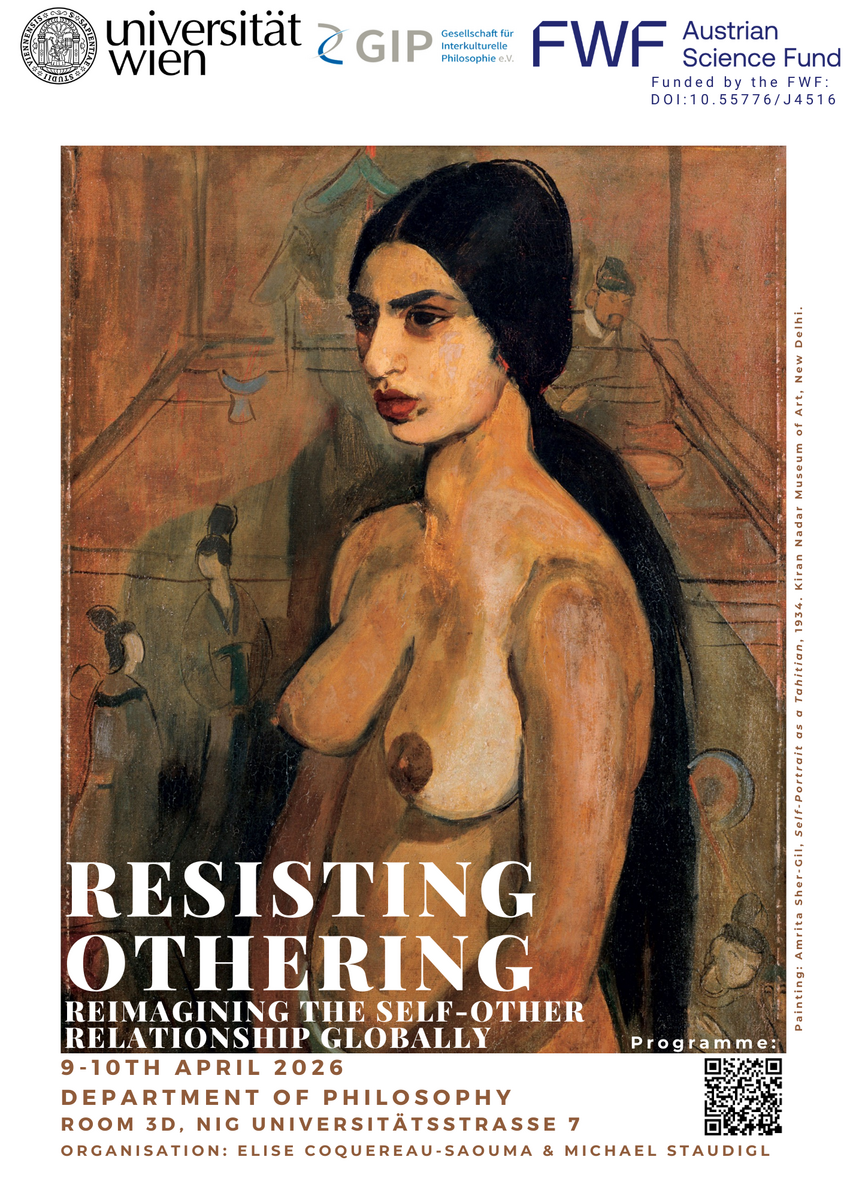

Resisting Othering
Reimagining the Self-Other Relationship Globally
9–10 April 2026
Department of Philosophy, Room 3D
NIG, Universitätsstraße 7
Organisation: Elise Coquereau-Saouma & Michael Staudigl
Otherness is still most often conceived in distinction from the self, as in the figure of the foreigner or the barbarian—the other of my culture. The other thus serves, through a play of resemblance and difference, to delineate who I am and to which societies, communities, cultures, and groups I belong, notably by contrast and opposition. This space between self and other easily takes on an exclusionary value, sometimes with radical consequences: the pariah, the untouchable, or, likewise, the refugee camps behind barbed wire at the border. This binary between self and other can be politically exploited to set different societies, religions, or communal groups against each other. It can also serve as a justification for the exploitation of nature. It can manifest in less visible and less extreme, but no less problematic, examples of othering processes. In this workshop, we aim to question what makes the exclusion of others possible, starting from the very conception of alterity that underpins our models of exclusion. In other words, the goal is to develop conceptual alternatives to these processes of othering.
While much of the philosophical literature addressing these issues has emerged from Western traditions, non-Western models of alterity can offer significant and as yet underexplored contributions to these questions. These approaches, rooted in diverse local contexts and practices, may often be more attuned to the specific forms of exclusion and othering encountered in those societies, and thus provide conceptual resources that cannot simply be replaced by universalizing Western frameworks.
Accordingly, this workshop seeks not only critical analyses of exclusionary practices, but above all positive theories of relation to the other—approaches that move beyond the binary of self and other and ground new models for thinking alterity. We invite contributions that articulate such alternative frameworks, whether through concepts of nondualism, interdependence, relational ontology, or other traditions of thought that resist the reduction of alterity to opposition. Our aim is to foster a space for proposals that do not merely critique, but actively reimagine the self’s relation to the other, drawing on the richness of non-Western traditions to shape a genuinely global theory of alterity relevant for our time.
9 April
9:00–10:00
“I am Thou” and “I with Others = We”: Nondualism Debated in Ramchandra Gandhi and N. V. Banerjee’s Philosophies
Elise Coquereau-Saouma, University of Vienna
10:00–11:00
The I, the Other and the Thou in Mutual Self-Negation: A Phenomenological Account of Intersubjectivity in Nishida Kitarō’s Philosophy of Basho
Georg Harfensteller, University of Vienna
11:30–12:30
The Self–Other Relationship in African Philosophy: Ubuntu and Igwebuike in Comparison
Emmanuel Ossai, Lancaster University
14:00–15:00
From Universal Compassion to Alienation: Contrasting Models of Self–Other Relations in Early and Later Jain Philosophy
Dimitry Shevchenko, Hebrew University
15:00–16:00
Is India Civilized? Rethinking the Self–Other Relationship with William Archer (1856–1924), John Woodroffe (1865–1936), and Aurobindo Ghose (1872–1950)
Pawel Odyniec, Karlstad University
16:30–17:30
Having the Savage: On Matters of Self, Other, and How to Humanise Our Monsters
Manu Sharma, University of Vienna
10 April
9:00–10:00
“The Empire Strikes Back”: Notes on Barbarians, Cannibals, and Terrorists
Michael Staudigl, University of Vienna
10:00–11:00
Othering as Experiential Maladaptation: A Phenomenological Account
Sergio Pérez-Gatica, University of Tübingen
11:30–12:30
Relational Thinking? On the Challenges of Relational Epistemologies
Anke Graness, Hildesheim University
14:00–15:00
Philosophy as Resistant Praxis: Buddhist Perspectives
Fabien Muller, Tampere University
15:00–16:00
Agency as Relationally Emergent: Defending Confucian Role Ethics against Collectivist Misreadings
Thomas Moore, Sheffield University
16:30–17:30
Imagining an-other: On the Figure of Otherness in Global Romanticism
Michael Zangerl, University of Vienna
Supported by the Austrian Science Fund (FWF): DOI:10.55776/J4516